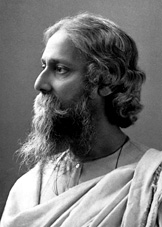
 गुरुदेव रविंद्रनाथ टैगोर भारत के ल्योंअर्द विंची थे. उनकी बहुमुखी प्रतिभा उनके सृजित साहित्य ,संगीत,कला , नरतिय व् गायन शैली अनेकों रूपों मैं प्रस्फुटित हुयी है. उनकी देश भक्ति उनके अंग्रेजों द्वारा दिए गए सम्मान पदक को लटते समय दिए गए वक्तव्य से छलकती है. नीचे दिया लेख से उनके जीवन के अनेक पहलुओं को प्रकाशित करता है .
Rabindranath Tagore
(1861-1941)
(A Freedom Fighter)
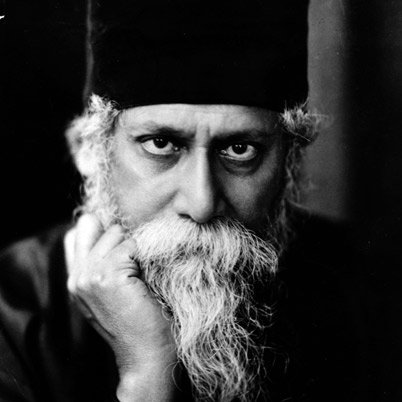
“Blessed I am that I am born to this land”, so has said Rabindranath Tagore. If there was a truly many-splendored genius ever, Tagore filled in the bill most magnificently. Universally acknowledged as a poet and composer of what one knows by the name, “Rabindrasangeet”, Rabindranath was one who, after Swami Vivekananda, took the nation to the world stage. A quintessential poet-philosopher, he, however, eventually synthesized the East and the West in a manner so as to completely nullify Rudyard Kipling’s much-touted statement that ‘The East is East , the West is West; the twain shall never meet”. Indeed, India is the one place where these two steams of culture got intertwined in more than one sense.
Born in the then most well-known aristocratic Tagore family (in Jorasanko area in the then Calcutta) in the Brahmo Samaj, the most elite section among the Bengali intelligentsia at that time, Rabindranath was the son of an illustrious man Maharshi Devendranath Tagore. Steeped in basic Indian culture and education at home, Tagore is the history’s most famous ‘school drop-out’. He never earned any school or college certificate. Showing his rare literary talent at a very early stage, he rose to become the ‘best’ poet and composer in Bengali (but equally excelling in English prose and literary essays) so much so that his compilation of basically devotional poems and songs, ‘Gitanjali’ translated in English by the poet himself, earned him the first Nobel prize for the country, and for that matter, for the entire Asia. His writings are so voluminous that one would find it difficult to copy these down even in one’s life-time. “Rabindrasangeet’ was his passion, the labour of love. There is no aspects of human emotion that has not found reflection in his songs and poems. He virtually left nothing in the world of arts untouched, be it poetry, prose, essays, novels, short-stories, dramas, painting, sculpture, staging dramas and even taking part in character roles in some cases. He was, above all, a teacher in music par excellence.
To express Tagore in his own words, “I am a shy individual brought up in retirement from my young days. And yet my fate takes every opportunity to drag me into a crowded publicity. I often wish that I had belonged to that noiseless age when artists took their delight in their work and forgot to publish their names. I feel painfully stupid when I am handled by the multitude who by celebrating some particular period of my life indulge in their avidness of some sort of a crowd ritual which is mostly made of unreality”. Thus, always yearning to stay away “Far From The Madding Crowd”, he finally found the abode of peace at Santiniketan, where he founded the ‘Vishwabharati’, his ideal for universalism on the philosophy of “Vasudeva Kutumbakam”. In the immortalwords of the poet,
“The West has today opened its door,
There are treasures for us to take,
We will take and we will also give,
From the shores of India’s immense humanity”.
Indeed, assimilation and synthesis were the key notes in his philosophy of universalism, practised in Vishwabharati. More than that, Tagore had created so much impact during his short visits to China and Japan that scholars from those countries are regular students or residents to this abode of peace. Foreign scholars visit this place to learn Bengali so as to be able to taste Raabindranath in his mother tongue. Many among them never return. The President of India is the standing Chancellor of the University of Vishwabharati and the incumbent of that post considers it a privilege to hold that honour. There is hardly any dignitary in the past or in the present who has failed to pay pilgrimage to this revered place. It was Tagore who gave the title “Mahatma” to M.K. Gandhi, who in turn called Tagore the “Gurudev”. As his well-known bearded pictures express, he had a debonair, charismatic and magnetic personality. Hardly was there any internationally known person of his times, including even Mussolini, who had not met him and had fallen under his charms.
As it has happened, Tagore is the composer of not only our national anthem, “Jana Gana Mana”, another of his poem-cum-song, namely, “Aamar Sonar Bangla” has been chosen the national anthem of Bangladesh. A unique distinction indeed! To add, one of his tunes has been used (officially) as the basis of the national anthem in Sri Lanka.
Rabindranath Tagore lived at a time when the nation was passing through a critical phase of its freedom struggle. Although he chose not to take direct part in the freedom movement for various reasons, the nationalist in Tagore, burning within all the while, took him on the streets of Calcutta in the ‘Banga Bhanga Andolan’ (stop dividing Bangla)launched against Lord Curzon’s plan to divide Bengal in 1905. Tagore led the march, tied ‘rakhi’ in every one’s hand, irrespective of religion or caste, expressing love and solidarity with all. He was, however, soon disillusioned over the political exploitation of the Hindu-Muslim conflict, and so withdrew himself from the “Swadeshi Andolan”. His first seminal essay, ‘Swadeshi Samaj’ (Our State and Society), explaining his thoughts on the political problems of the nation was earlier published in 1904. Because of his firm belief in universalism, his concept of nationalism did not go will with many of his times. He, however, continued to take pains in elaborating his thoughts of nationalism, both in writing and more conspicuously through the series of lectures, delivered both inside the country and outside (China, Japan, USA, UK). His famous Hibbert Lectures in Oxford was published in the form of “Religion of Man”. His final lecture, ”Crisis in Civilisation” ( Savatyaar Sankat), composed during the heydays of the second World War, remains a classic in its own rights.
A man who maintained a high level of composure, even after having gone through any amount of miseries in his personal life, had been internally suffering intensely at the rude and crude way, the Britishers treated the freedom fighters at all levels. Tagore could not possibly take it further when the infamous British Brigadier General Dyer opened fire, without an provocation, on the armed people that had gathered at Jallianwala Bagh, killing nearly 1000 people on the spot and injuring more than 1500 others. The ‘wounded’ man straightaway renounced (1919) the British knighthood bestowed on him (1915) earlier. The letter he had then written is worth reading a thousand times. Published in The Statesman of Calcutta on June 3, 1919, it is reproduced below. If you have read it once, you cannot help going through it once again.
Quote(.)
Your Excellency,
The enormity of the measures taken by the Government in the Punjab for quelling some local disturbances has, with a rude shock, revealed to our minds the helplessness of our position as British subjects in India. The disproportionate severity of the punishments inflicted upon the unfortunate people and the methods of carrying them out, we are convinced, are without parallel in the history of civilised governments, barring some conspicuous exceptions, recent and remote.
Considering that such treatment has been meted out to a population, disarmed and resourceless, by a power which has the most terribly efficient organisation for destruction of human lives, we must strongly assert that it can claim no political expediency, far less moral justification. The accounts of the insults and sufferings by our brothers in Punjab have trickled through the gagged silence, reaching every corner of India, and the universal agony of indignation roused in the hearts of our people has been ignored by our rulers, possibly congratulating themselves for imparting what they imagine as salutary lessons.
This callousness has been praised by most of the Anglo-Indian papers, which have in some cases gone to the brutal length of making fun of our sufferings, without receiving the least check from the same authority, relentlessly careful in something every cry of pain of judgment from the organs representing the sufferers. Knowing that our appeals have been in vain and that the passion of vengeance is building, the noble vision of statesmanship in our Government, which could so easily afford to be magnanimous, as befitting its physical strength and normal tradition, the very least that I can do for my country is to take all consequences upon myself in giving voice to the protest of the millions of my countrymen, surprised into a dumb anguish of terror.
The time has come when badges of honour make our shame glaring in the incongruous context of humiliation, and I, for my part, wish to stand, shorn of all special distinctions, by the side of those of my countrymen who, for their so called insignificance, are liable to suffer degradation not fit for human beings. And these are the reasons which have compelled me to ask Your Excellency, with due reference and regret, to relieve me of my title of knighthood, which I had the honour to accept from His Majesty the King at the hands of your predecessor, for whose nobleness of heart I still entertain great admiration.
Yours faithfully,
Rabindranath Tagore
Calcutta,
6, Dwarakanath Tagore Lane,
May 30, 1919 Unquote(.)
The ‘freedom fighter’ had indeed spoken in his inimitable way! And, with this, the Britishers must have learnt their lesson that their time in India was up. Long live Tagore, the freedom fighter!
