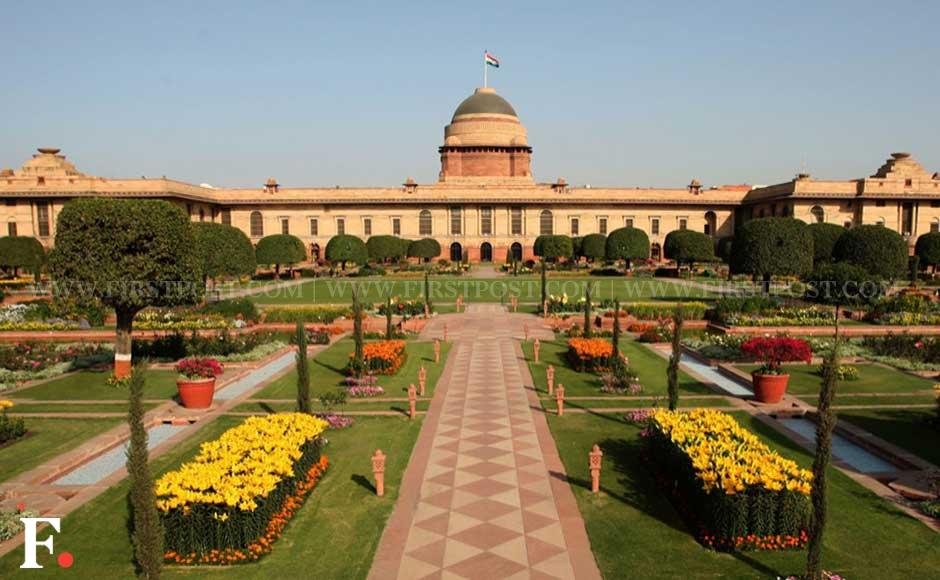
 राष्ट्रपति भवन के अवमूल्यन का इतिहास बहुत पुराना है. एक बार एक मित्र देश के राष्ट्रपति यहाँ ठहरने के दुसरे दिन दिल्ली की बदनाम जी बी रोड पर चुप चाप राजदूत की कार मैं चल दिए .सुरक्षा एजेनसियों मैं खलबली मच गयी . ये समस्या पहले कभी नहीं आयी थी.पर यह सज्जन रूस मैं भी यही करते पकडे गए. रूसियों ने एक जासूस औरत को उनके कमरे मैं भेज कर फोटो ले लिए और उन्हें अपने मतलब के लिए प्रयोग किया.
१९९० के दशक से विदेशी मेहमानों ने राष्ट्रपति भवन मैं रहना कम कर दिया . रूस के येल्स्तिन और इंग्लैंड के जॉन मेजर आखिरी विदेशी मेहमानों मैं से थे जो वहां रुके.
क्लिंटन ,चिरक , कोहल इत्यादि वह लोग हैं जिन्होंने राष्ट्रपति भवन मैं ठहरने से मना कर दिया.
राष्ट्रपति भवन मैं राजदूतों का अपने परिचय पात्र देना एक बड़ी घटना होती है जिसका सब इन्तिज़ार करते हैं .चीन मैं तो राजदूत राष्ट्रपति से बस एक बार ही मिल पाते हैं .
डा कलाम का अपना अलग व्यक्तित्व था . प्रतिभा पाटिल को राष्ट्रपति भवन के इतिहास मैं कोई रूचि नहीं थी.
प्रणब मुख़र्जी अब कुछ प्रयास कर रहे हैं .
इस टेलीग्राफ के लेख को लिंक पर क्लिक कर पढ़ें
http://www.telegraphindia.com/1130731/jsp/opinion/story_17173956.jsp#.UfobINK6Zjo
|
THE PRESIDENT AT HOME – Tradition and change at Rashtrapati Bhavan |
|
|
K.P. Nayar |
|
My favourite Rashtrapati Bhavan story is about a visiting head of state who stayed there, successfully escaped its confines and restrictions, which inevitably come from being a state guest, and was then unsuccessfully shamed by his hosts for having attempted a shocking escapade. This head of state, a hero of his country’s independence movement and a close friend of Jawaharlal Nehru, also had a reputation as an irrepressible womanizer. True to that reputation, on the second night of his stay at Rashtrapati Bhavan, this state guest persuaded his ambassador to smuggle him out in his diplomatic car after his hosts had retired for the night and take him to a woman on G.B. Road, the only red light area of Delhi in those years. An alert member of the guest’s local security detail noticed the visiting president’s departure and within minutes an emergency meeting was called by his higher-ups who were concerned about the guest’s safety. After all, the visitor was a global pioneer against anti-imperialism, and decolonization was still a dream for many countries. Moreover, only months earlier, there had been an assassination attempt, which the leader narrowly survived, one of many before and after, plotted by his enemies at home and abroad. Human intelligence at the disposal of the government had no difficulty tracing a diplomatic car parked on G.B. Road, although the ambassador had the discretion not to fly his national flag with his president travelling in the vehicle. A dynamic, young Indian Police Service officer who was in charge of guest’s security decided that when the ambassador’s car returned to Rashtrapati Bhavan with the visiting president, the lights would go up along the vehicle’s route keeping pace with its advance until the guest alighted in the presidential porch. Moreover, the entire route along Rashtrapati Bhavan would be lined by policemen who would salute the guest at regular intervals like a guard of honour. The IPS officer, who told me the story also confessed defeat. The state visitor was unfazed and the attempt to shame him was like water off a duck’s back. Many decades later, when I narrated this episode at a party in Moscow, a Russian friend confessed to a similar defeat. The same president, whose identity diplomats of my generation would have no difficulty guessing, was a guest at the Kremlin and the Soviets saw to it that he smuggled a woman into his suite. The female, a willing Russian spy, and her lover were secretly photographed and the pictures were then shown to the visitor who was acting difficult with the Soviet leadership since he was a nationalist to the core and unwilling to be a satellite in the manner of East Europeans. As in New Delhi, this state guest disarmed his hosts in Moscow when he asked for more of those compromising photos insisting that his stock would go up among friends back home if he flaunted them. Foreign guests began fleeing Rashtrapati Bhavan in the early 1990s. Russia’s Boris Yeltsin and Britain’s John Major were the last among the big power leaders to spend nights there. The exodus started with Helmut Kohl of Germany, and the process was cemented when Jacques Chirac of France firmly said no to his host, and Bill Clinton followed some years later. The change had nothing to do at all with restrictions that the hero of my favourite story chafed at. It had everything to do with the deterioration in standards at the president’s estate and the inability of Rashtrapati Bhavan to keep pace with the demands of a 21st-century state house. I recalled my favourite story at this time, however, because one of the less publicized initiatives by Pranab Mukherjee, as he observes his first anniversary as head of state, relates to his interaction on the president’s estate with interlocutors from abroad. At embassies in Chanakyapuri, there are many Indophiles who are on their second or third postings in India after intervals spanning many years — in some cases, several decades. Privately, almost all of them regret the damage which K.R. Narayanan inflicted on the presidency in terms of its diplomatic identity. Ambassadors posted to New Delhi used to look forward to the day they would present their credentials to the president — until Narayanan stripped the occasion of most of its ceremony and splendour. For envoys from small countries or those with little more than formal ties with India, the pomp of the credentials day, beginning with the grandeur of an individual reception in the Rashtrapati Bhavan forecourt, was something to tell their grandchildren and show off with photographs, long after their retirement from the diplomatic service. For others with substantive engagement with India, from the Bhutanese in the neighbourhood or the Japanese in the Far East to the Canadians in North America, it was sometimes the only chance for a private chat with the president during their entire tenure in Chanakyapuri. Narayanan destroyed the diplomatic sanctity of the tete-à-tete. A.P.J. Abdul Kalam had other priorities in office and Pratibha Patil had no interest in doing anything to correct it. Indeed, she had little interest in any substantive aspect of statecraft or was incapable of dealing with such issues. Mukherjee, it is clear at the end of a year in Rashtrapati Bhavan, remains a diplomat at heart. Two stints as external affairs minister aside, among India’s defence ministers he had the most globalized vision of all. Even as finance minister, Mukherjee brought to the job a high level of international outreach, bringing about unprecedented changes in North Block’s engagement of international financial institutions. Yet, his personality militates against any drastic perestroika — restructuring — in Rashtrapati Bhavan’s foreign outreach, lest it be interpreted as an attempt to denigrate his predecessors even as he gingerly introduces a diplomatic glasnost — openness — within the presidency. Mukherjee has decided, for now, to continue the practice of ambassadors presenting their credentials to him in groups in a single day with each envoy walking up to him individually to hand over the letter of credence. But thereafter, Mukherjee has made time for each ambassador or high commissioner to meet him individually and have a private conversation. The worst change that Narayanan brought about, which his two successors did nothing to remedy, was to have several envoys presenting their credentials on a single day and then also call on him in a group. That arrangement discomfited everyone and left a bad taste in the mouths of new envoys, for whom it was one of the biggest days of their posting to be with the host country’s head of state. Understandably, Pakistan’s high commissioner may not want to say something to the president within earshot of his counterpart from Bangladesh, or the Japanese ambassador would not confide in anyone in the presence of his Russian counterpart. Throughout New Delhi’s sprawling diplomatic enclave, the change initiated by Mukherjee has been widely appreciated and it has restored much of the meaning of the credentialing occasion in Rashtrapati Bhavan. It is still a far cry from the practice in Beijing, where presentation of credentials is like a huge celebration: an entire embassy turns up, along with the ambassador, to meet the president. After all it may be the only time they may meet China’s head of state in such proximity during a three-year tenure. Hopefully, Mukherjee will gradually restore the bar that was set for such occasions by Jawaharlal Nehru and Rajendra Prasad. If that happens and his plans to inject efficiency into the functioning of Rashtrapati Bhavan by a programme of modernization and optimum utilization of resources bear fruit, a time may come when state guests once again look forward to staying on Raisina Hill instead of checking into hotels, a practice which robs state visits of some of their camaraderie and tradition. |
